Every Badge on the Spain World Champions Shirt, Decoded
By Patch FC Editorial Team · Last updated 2026-08-26 · Sources: Footy Headlines, Yahoo Sports, Tribuna
If you're looking at Spain's shirt since the final and trying to work out what all that gold actually means, here's the whole answer up front. The shirt carries five separate marks, and no two of them say the same thing. The gold shield on the chest says Spain are world champions right now. The two stars above the crest count the titles: 2010 and 2026. The gold "26" on the right sleeve is the tournament badge former champions wore during the World Cup. The Euro 2024 champions patch marks a different title entirely. And on the final-day shirt, a line of small print records the night itself: SPAIN VS ARGENTINA, 19 JULY 2026, NEW YORK NEW JERSEY. Below, each one decoded — what it is, where it goes, and who's allowed to wear it.
The one rule that decodes the whole shirt
Read the shirt by position, not by color. Nearly everything on it is gold — the chest shield, the sleeve badge, even the lettering of the final print — and that's exactly why people collapse five different marks into "the gold badge." Color tells you nothing here. Position tells you everything:
The chest says now. The stars say forever. The sleeve says before. The Euro patch says elsewhere. The small print says one night.
Keep that line in your head and every section below is just the proof.
What is the gold shield on Spain's chest?
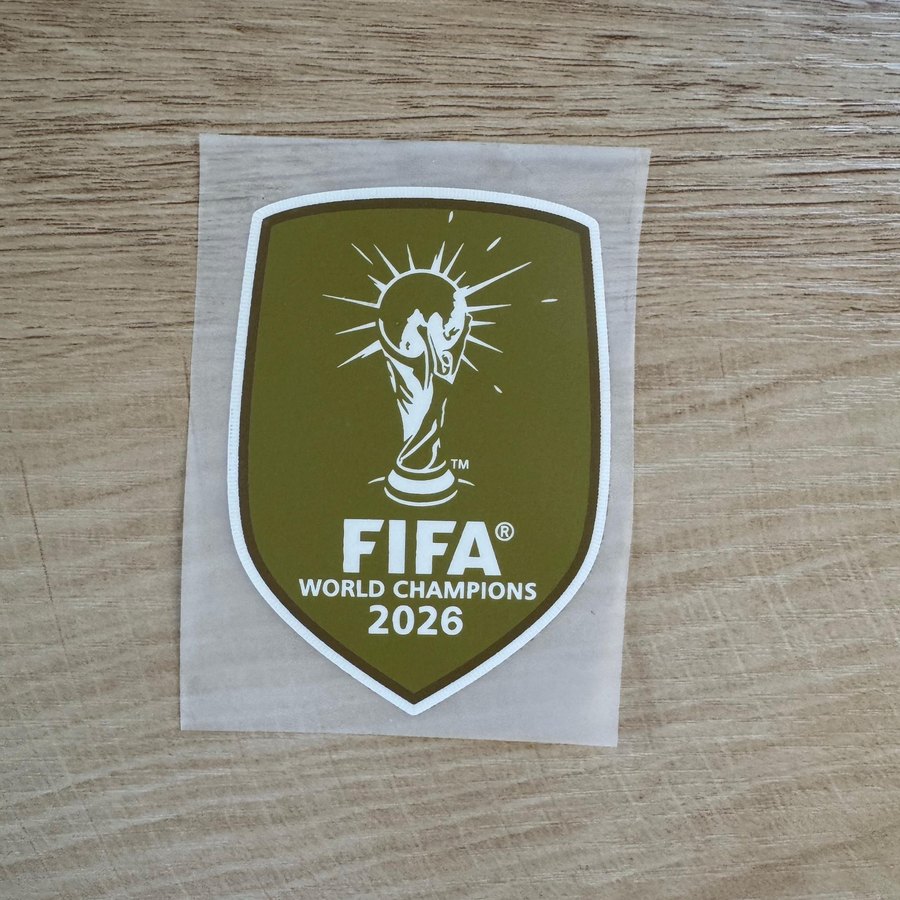
The World Champions badge: a gold shield with a white border, the trophy at the center, rays opening out behind it, and WORLD CHAMPIONS 2026 across the bottom.
Where it goes: on the chest, centered above the team crest. It is strictly a chest piece — it never appears on a sleeve.
Who can wear it: exactly one nation on the planet — the reigning world champion. Spain earned it by beating Argentina in the final on July 19, 2026, and it stays theirs until the 2030 final crowns the next champion. Argentina held it for the four years before that, as the 2022 winners, and handed it over on the night they lost it in the most literal way possible.
Of the five marks on this page, the shield is the only one that has to be given back. That handover clock is a story of its own; for this page, the point is simpler: chest gold means current champion, full stop.
What do the two stars above the crest stand for?
World Cup titles. One star per title, sitting directly above the team crest — and Spain's count went from one to two on July 19, 2026. The first star is 2010. The second is 2026.
Where they go: above the crest, as part of the crest presentation itself. They're not a separate patch you can point to; they live with the crest wherever the crest appears.
Who can wear them: the stars belong to the nation's history, not to any current status. That's the working distinction between the crest and the shield sitting just above it: the stars record what Spain has done; the shield certifies what Spain is. When the chest badge eventually moves on, the two stars stay — permanently.
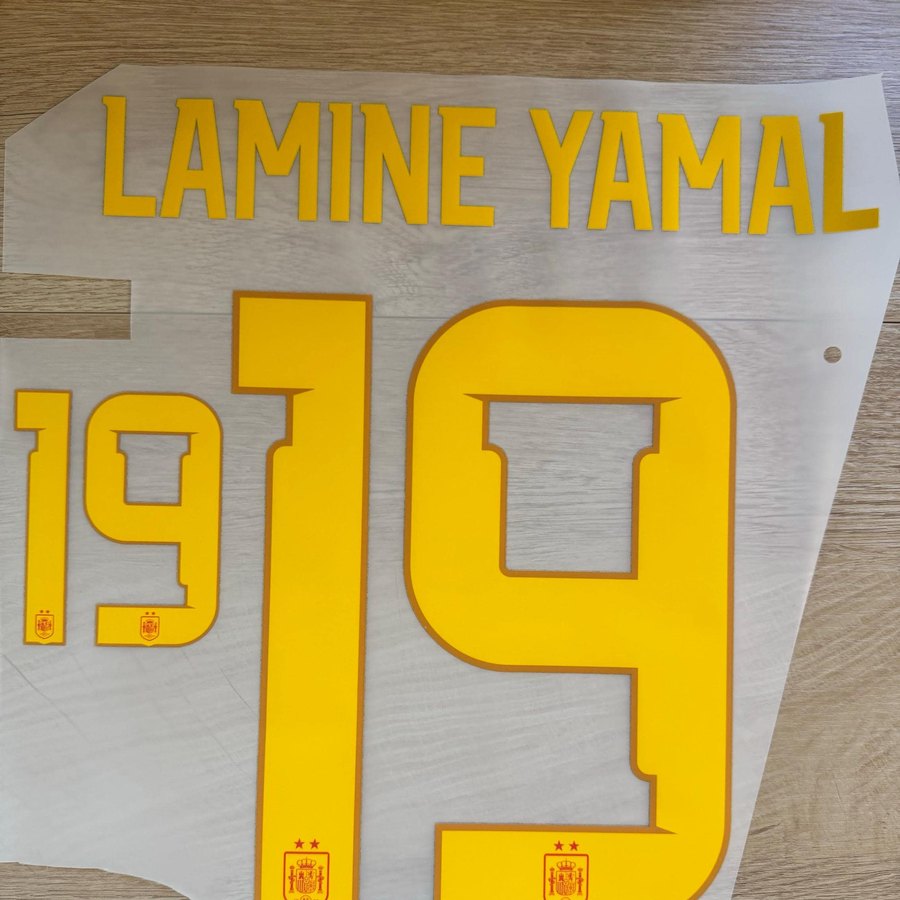
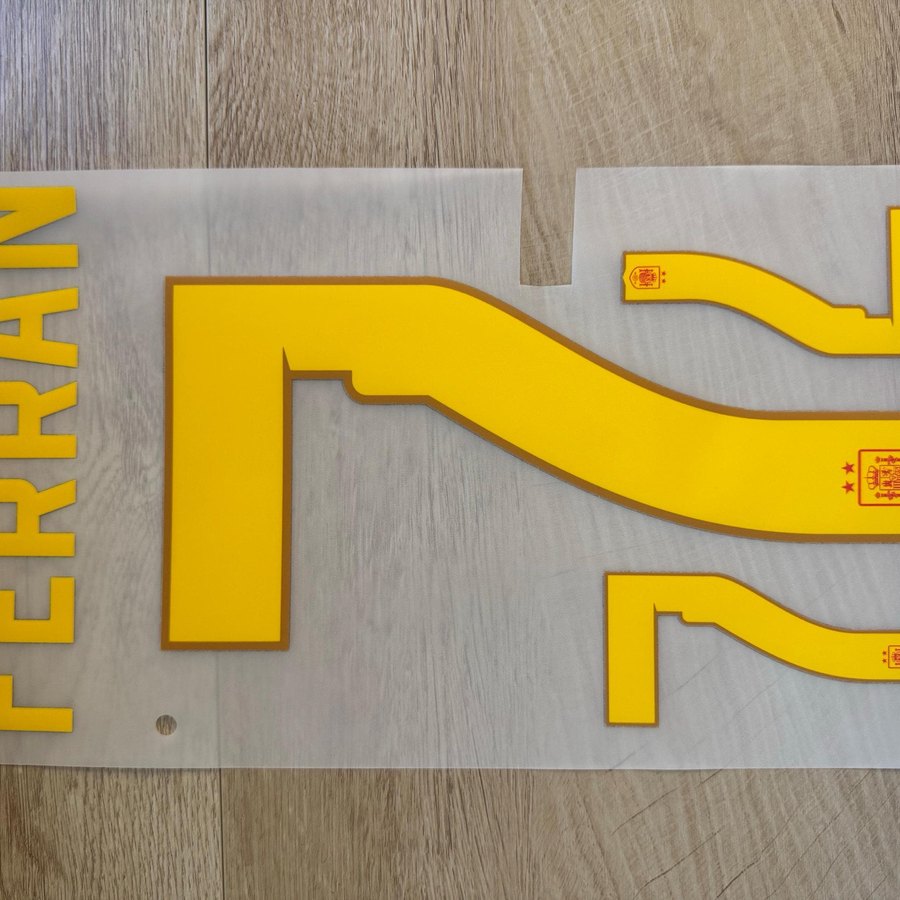
One practical detail: a Spain 2026 shirt bought before the final carries one star. The two-star crest belongs to everything produced after the night in New York New Jersey — down to details as small as the back namesets, which now carry the two-star crest on the sheet.
What does the gold 26 on the right sleeve mean?
That's the 2026 tournament badge in its gold colorway — the version reserved for former World Cup champions who qualified for the tournament.
Where it goes: the right sleeve.
Who can wear it: seven nations wore it at the 2026 World Cup: Brazil, Germany, Argentina, France, England, Uruguay and Spain. Spain's ticket into that club was the 2010 title. The other 41 teams in the field wore the standard badge in black or white — a color system with its own logic that we've covered separately.
The nuance that matters here: the sleeve badge is frozen to the tournament. It marks the summer of 2026, not the ongoing reign. Spain arrived as one of seven teams with gold on the sleeve, and left as the only one of the seven whose sleeve gold earned a chest upgrade.
Why is there a Euro patch on a World Cup champion's shirt?
Because Spain hold two titles at once. They're the reigning European champions from Euro 2024, and the holder of that title wears its own separate patch — a mark that has nothing to do with the World Cup at all.
Who can wear it: only the current European champion, the same one-nation logic as the World Champions shield, just for a different trophy on a different clock. It arrived on Spain's shirt before the world title did, and it expires on the Euro cycle, not the World Cup one.
The reason it belongs in this decoder: it's the third gold, champion-flavored mark on the same shirt, and it produces a first. Spain are in line to become the first national team to wear the Euro champions patch and the World Champions badge at the same time. No shirt has ever had to carry both claims at once.
What does the small print on the final shirt say?
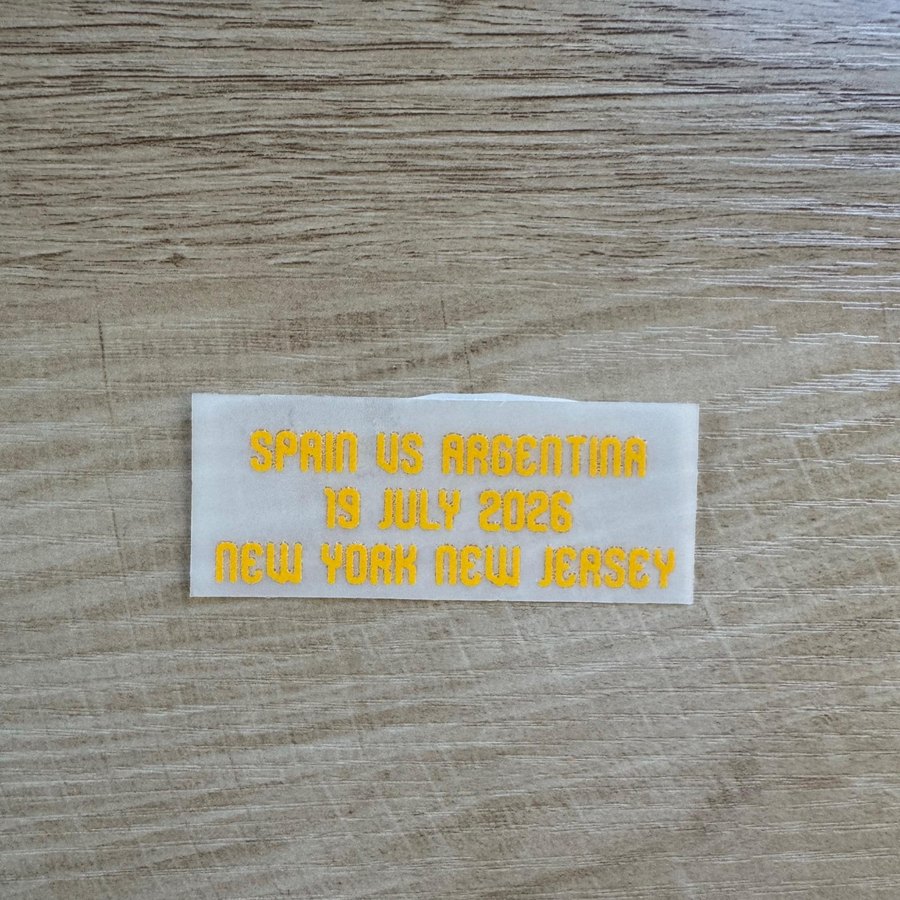
SPAIN VS ARGENTINA. 19 JULY 2026. NEW YORK NEW JERSEY. That's the match details print — the collector's mark of a final-day shirt: the fixture, the date and the venue, set in small lettering with no shield, no border and no emblem around it. On the shirt, only the text shows.
Where it goes: on the chest, sitting quietly under the crest zone — low-key by design, which is why casual viewers miss it and collectors look for it first.
Who can wear it: this is the one mark on the list that Spain doesn't own. The match details belong to the match, not to the title, so both finalists' shirts carried the same line. It's the only element here that names Argentina — and for an Argentina fan, that same print marks their shirt too.
Think of it as the shirt's timestamp. Every other mark on this page says something about status or history; the small print pins the shirt to one specific night.
Why do the three gold badges get mixed up?
Because they're all gold, they're all champion-related, and they can all appear on one Spain shirt. Search for "Spain's gold badge" and you'll find the chest shield, the sleeve 26 and the Euro patch discussed as if they were a single thing. They never are.
The fix is to ask what question the gold answers:
- Champion of the world right now? That's the chest shield — one team, held until the 2030 final.
- Won the World Cup at some point before? That's the sleeve 26 — seven teams, worn during the 2026 tournament.
- Champion of Europe, not the world? That's the Euro patch — a separate title on a separate clock.
And the fourth gold — the final match details lettering — isn't a badge at all. It's a print, and it doesn't claim a title; it names a game.
Shield means now. 26 means before. Euro means elsewhere. Print means one night. That's the whole disambiguation.
How does the full shirt read, top to bottom?
Put the five together and Spain's shirt reads like a record you can scan in seconds:
- Chest, above the crest — the gold World Champions shield: current world champions, Spain's until the 2030 final.
- The crest — two stars: the 2010 and 2026 titles, permanent.
- Right sleeve — the gold 26: former champion, worn at the 2026 tournament.
- The Euro patch — reigning European champions, a second title on its own clock.
- Under the crest, on the final shirt — SPAIN VS ARGENTINA, 19 JULY 2026, NEW YORK NEW JERSEY.
And the back finishes the story: name and number. The yellow LAMINE YAMAL 19 set and the gold FERRAN 7 are both cut for the red home shirt, and both sheets now carry the two-star crest — the update reaches every corner of the shirt.
Nothing gold on this shirt is decoration. Every mark is a specific claim — now, forever, before, elsewhere, one night — and every claim checks out.
A note on these pieces
The elements on this page exist as individual iron-on pieces. The World Champions shield is an adult-size chest badge that sits centered above the crest. The final match details come as a text transfer — yellow-gold lettering on a clear backing made for the red home shirt, with a navy version for light kits — so only the words show once applied. The namesets are back pieces: name over number, cut for the red Spain home shirt. This guide draws on reporting from Footy Headlines, Yahoo Sports and Tribuna.
FAQ
What are all the badges on Spain's world champions shirt?
Five marks, five meanings: the gold World Champions shield on the chest (current champion), two stars above the crest (the 2010 and 2026 titles), the gold 26 on the right sleeve (former champion, worn at the 2026 tournament), the Euro 2024 champions patch (reigning European champion), and on final-day shirts, the match details print naming Spain vs Argentina, 19 July 2026, New York New Jersey.
Are the two stars and the chest badge the same thing?
No. The stars count titles and never come off — Spain's shirts will carry two stars permanently. The chest shield marks the current champion only and moves on when a new champion is crowned at the 2030 final. They arrived together on the winners shirt, which is why they get bundled, but they run on opposite rules.
Does Argentina's shirt share any of these marks?
Two of them. Argentina wore the same gold 26 sleeve badge at the tournament, as a fellow former champion, and the final match details print names both teams — it marks an Argentina shirt exactly as it marks a Spain one. The chest shield is the mark that separated them: Argentina wore it into the final as the 2022 champions, and since that night it belongs to Spain.
Is the gold 26 sleeve badge still current after the tournament?
It's tied to the tournament, not to the reign. The gold 26 marks the seven former champions who played the 2026 World Cup, so it belongs to that summer's shirts. The mark of the ongoing reign is the chest shield — that's the piece that says current champion.
Is the Euro patch part of the World Cup badge set?
No. It marks a different title — European champions, from Euro 2024 — on a different cycle. It shares a shirt with the World Cup marks, which is the point: Spain are in line to become the first national team wearing the Euro champions patch and the World Champions badge at the same time.
Wondering about a specific nation? See what patch your team wears at the 2026 World Cup, or find your team’s patches in the Patch Finder.
Get the patches
Keep reading
What Is the Gold Badge on Spain's Shirt? The World Champions Badge, Explained
world cup 2026 patch by roundWorld Cup 2026 Patch by Round: Which Sleeve Badge for Every Stage
how to apply world cup patch heat pressHow to Apply a World Cup 2026 Sleeve Patch (Heat-Press Guide)
where to buy world cup 2026 sleeve patchWhere to Buy World Cup 2026 Patches & What's a Fair Price (US Shipping)
Patch FC sells heat-press patches for personal jersey customization. Ships from the USA.