How to Apply a World Cup 2026 Sleeve Patch (Heat-Press Guide)
By Patch FC Editorial Team · Last updated 2026-06-26 · Sources: FIFA, Footy Headlines, nss-sports
Applying a sleeve patch to your shirt is the kind of small detail that makes a jersey feel finished. Be straight with yourself about one thing first, though: these are heat-press patches. They bond with controlled heat and firm, even pressure — the kind a heat press delivers. This guide walks you through exact sleeve placement, the right temperature, pressure and timing, how to peel the carrier film, and how to keep the patch on for good.
There's no factory application step — you (or a heat-press shop) apply them yourself.
Do I Need a Heat Press?
Yes. Each badge has a heat-activated adhesive backing and a clear carrier film over the front, and that adhesive only bonds properly under the even heat and steady pressure of a heat press. A household clothes iron can't hold a flat, uniform temperature or apply consistent pressure across the whole patch, so the bond comes out patchy and corners lift after a wash or two. If you don't own a heat press, any local jersey-customization shop, screen-printer or heat-press studio can apply them in a couple of minutes.
Which Sleeve Does the World Cup Patch Go On?
This is the question that trips most people up, so let's settle it first. There are two different patches, and they live on opposite sleeves.
Right sleeve: the tournament badge
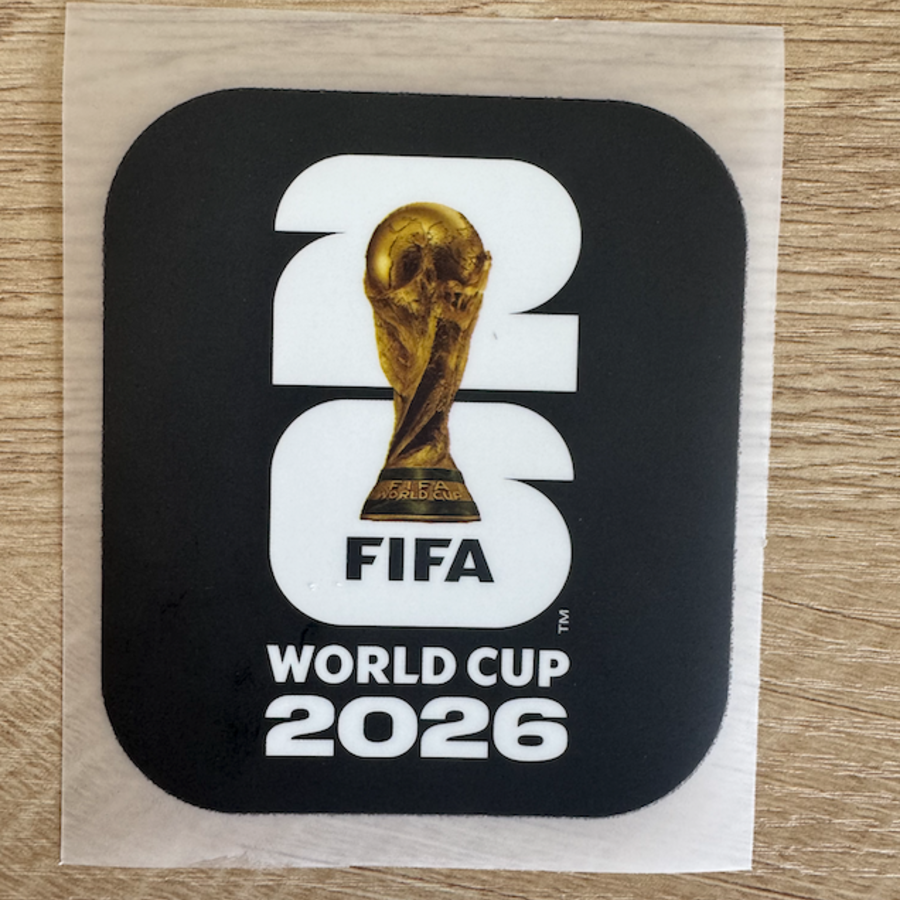
The tournament badge — the "26" emblem — goes on the right sleeve. This is the patch that stays the same all tournament long. It comes in a few colorways: a gold version worn only by the seven former World Cup champions in the field (Brazil, Germany, Argentina, France, England, Spain, and Uruguay), and black or white versions worn by everyone else. The light-versus-dark choice within the standard family is just for kit contrast — a light badge on a dark shirt, a dark badge on a light shirt — so a team's home and away kits can carry different shades of the same badge.
Left sleeve: the round patch
The round patch goes on the left sleeve, and this is the one that changes by stage of the tournament. Group stage, knockouts, semis, final — each round has its own patch design and colorway. If you're collecting patches across rounds, you'll swap the left-sleeve patch to match whichever round you're commemorating.
So the simple rule to memorize: right sleeve never changes (tournament badge), left sleeve rotates by round. Get those two reversed and a sharp-eyed fan will spot it instantly.
Where exactly on the sleeve?
Position the patch on the outer face of the sleeve, centered, roughly 1 to 1.5 inches (about 3 to 4 cm) below the shoulder seam — so it sits front-and-center when your arm hangs naturally at your side. Put the shirt on or lay it flat and eyeball it against where pro kits carry theirs: high on the bicep, not down by the elbow. Mark the spot lightly with a pin or a dab of removable fabric chalk before you commit any heat.
How to Heat-Press a Soccer Patch (Step by Step)
What you'll need
- A heat press (clamshell or swing-away)
- A Teflon or parchment sheet to protect the badge and the shirt
- A spare pressing pillow or pad, helpful for getting even contact on a sleeve
- The patch and the correct sleeve identified
The steps
-
Pre-press the sleeve. Close the press over the bare spot for 3 to 5 seconds to flatten the fabric and drive out moisture. Most jerseys are heat-sensitive polyester, so keep the temperature moderate and always work through a protective sheet.
-
Position the patch. Place the patch — adhesive side down, clear carrier film facing up — on the spot you marked. Double-check the sleeve (right = tournament badge, left = round patch) and that it's centered and straight. This is your last chance to adjust.
-
Cover with a Teflon or parchment sheet. This protects both the badge and the shirt from direct contact with the platen.
-
Press with heat and firm pressure. Set the press to roughly 300–320°F (150–160°C) with medium-firm pressure and press for about 12 to 15 seconds. Follow the heat and timing on the card that ships with your order if it differs — that's tuned to the specific badge.
-
Peel the carrier film. Lift the press, let the patch cool for a few seconds, then slowly peel away the clear plastic carrier film from the front of the badge — just like any heat-press patch. If the film tugs at the embroidery, lay the sheet back over it and press a few seconds more, then peel again.
-
Final press to set. Lay the Teflon sheet over the bare badge and press once more for 5 to 8 seconds to lock the edges down.
-
Let it cool completely. Let the patch cool fully before you move the shirt. The adhesive sets as it cools, and lifting a corner while it's still warm weakens the bond.
Temperature, Time, and Pressure: Getting It Right
These three variables decide whether your patch lasts one wash or one hundred.
- Temperature: Aim for 300–320°F (150–160°C). Too cool and the adhesive never fully activates; too hot and you risk scorching the jersey's synthetic fabric (most jerseys are polyester, which melts and shines at high heat — never crank it to the max).
- Time: Around 12–15 seconds under firm pressure, plus a short re-press after peeling the film. Use the timing on the card included with your patch when it's available.
- Pressure: Firm and even. The adhesive needs to be physically pushed into the fabric weave. Light or uneven pressure is the most common reason a patch peels — which is exactly why a household iron falls short.
A quick note on jersey fabric: because most kits are heat-sensitive polyester, always use a Teflon or parchment sheet and never let the bare platen touch the shirt.
The No-Wash Window: Don't Ruin It on Day One
Here's the rule that saves more patches than any other: wait at least 24 to 48 hours before washing the shirt for the first time. The adhesive needs time to cure and reach full strength after it cools. Throw it in the wash too soon and you'll undo a perfectly good application.
After that initial window, treat the jersey gently to make the patch last:
- Wash cold and inside out. Turn the shirt inside out so the patch isn't scraping against the drum and other clothes.
- Gentle cycle, mild detergent. Skip harsh detergents and high-spin cycles.
- Air dry. Never tumble dry. Heat from a dryer is the fastest way to loosen the adhesive. Hang it up instead.
- Don't press directly over the patch in future. If you need to iron the shirt, work around it or use a cloth.
Follow that and a properly heat-pressed patch will easily survive a full season of wear and washing.
Quick Recap
- These are heat-press patches — apply with a heat press, not a household iron.
- Right sleeve = tournament badge (the "26," stays the same all tournament).
- Left sleeve = round patch (changes by stage).
- Center it high on the sleeve, ~1–1.5 inches below the shoulder seam.
- Press at 300–320°F, medium-firm pressure, 12–15 seconds, through a Teflon sheet.
- Peel the clear carrier film after a short cool-down, then re-press the edges.
- Let it cool fully, then wait 24–48 hours before the first wash. Cold wash, inside out, air dry.
FAQ
Which sleeve does the World Cup patch go on?
Two patches, two sleeves. The tournament badge (the "26" emblem) goes on the right sleeve and stays there the whole tournament. The round patch — the one that changes by stage — goes on the left sleeve. Don't reverse them.
Can I apply these patches with a household iron?
We don't recommend it. These are heat-press patches: a household iron can't hold a flat, even temperature or apply consistent pressure, so the bond ends up uneven and corners lift. Use a heat press, or have a jersey-customization shop apply them — it only takes a couple of minutes.
What temperature and pressure should I use?
Around 300–320°F (150–160°C) with medium-firm pressure for about 12–15 seconds, through a Teflon or parchment sheet, then peel the carrier film and re-press the edges briefly. Use the card included with your patch if it lists specific settings. Never use the maximum setting — jerseys are usually polyester and will scorch or shine under high heat.
Do I peel anything off the patch?
Yes — there's a clear plastic carrier film over the front. You peel it after pressing and a short cool-down, exactly like any heat-press patch. Don't peel it before you press.
How long should I wait before washing my jersey after applying a patch?
Wait at least 24 to 48 hours so the adhesive can fully cure. After that, wash the shirt cold and inside out, and always air dry — tumble drying is the quickest way to loosen a heat-pressed patch.
Will a heat-pressed patch stay on?
A properly applied patch — correct temperature, firm pressure, carrier film peeled, full cool-down, and a 24–48 hour no-wash window — will comfortably last a full season of normal wear and gentle washing.
Wondering about a specific nation? See what patch your team wears at the 2026 World Cup, or find your team’s patches in the Patch Finder.
Get the patches
Keep reading
What Is the Gold Badge on Spain's Shirt? The World Champions Badge, Explained
world cup 2026 patch by roundWorld Cup 2026 Patch by Round: Which Sleeve Badge for Every Stage
where to buy world cup 2026 sleeve patchWhere to Buy World Cup 2026 Patches & What's a Fair Price (US Shipping)
world cup champions gold patch 2026Gold vs Standard: What Your Team's World Cup 2026 Sleeve Badge Color Means
Patch FC sells heat-press patches for personal jersey customization. Ships from the USA.