What Is a Match Details Transfer? The Small Print That Marks a Final Shirt
By Patch FC Editorial Team · Last updated 2026-08-26 · Sources: Kitroom Football, Time Out New York
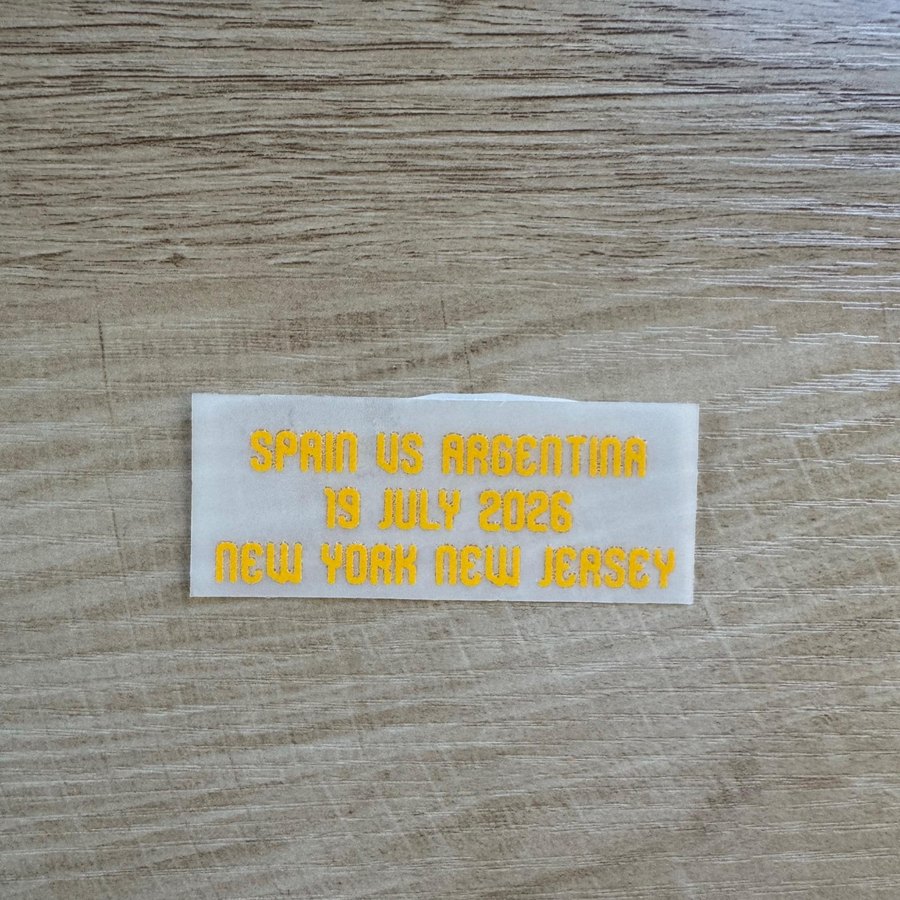
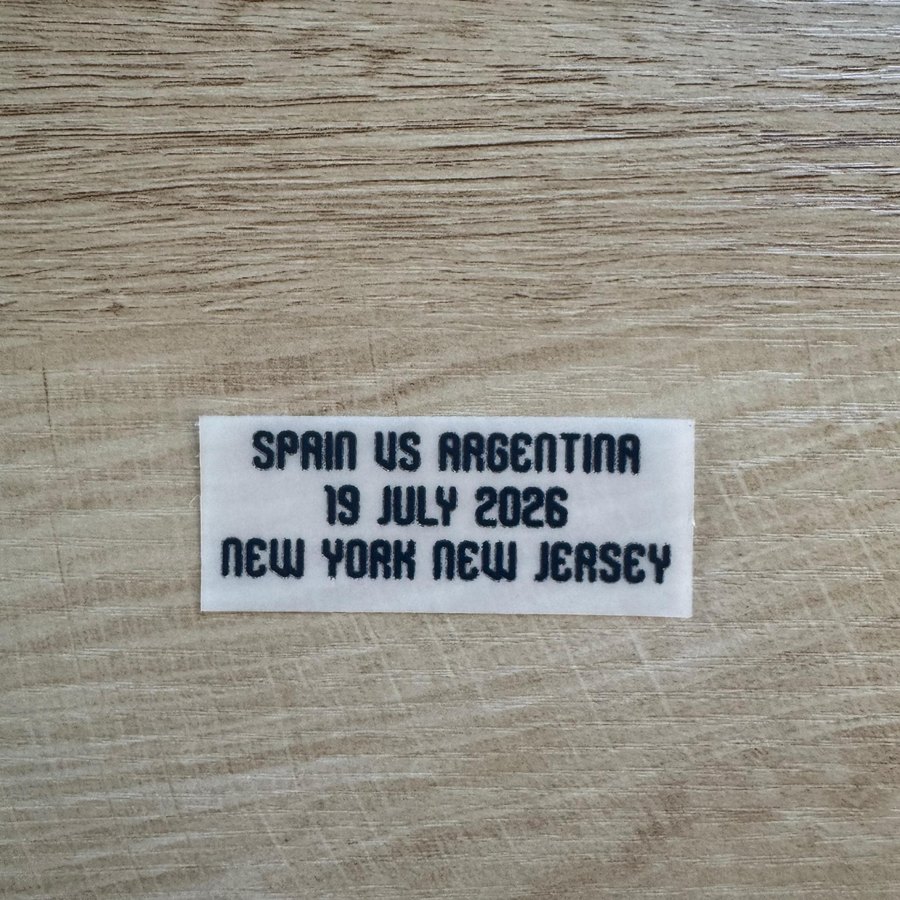
A match details transfer — MDT, in collector shorthand — is the small block of printed text on a football shirt that records one specific match: the two teams, the date, and the venue. It's the detail that separates a shirt prepared for a particular game from the identical shirt hanging in a store. The crest, the badges, the colors — all of that is the same on both. The match details text is not. For the 2026 World Cup final, it reads: SPAIN VS ARGENTINA / 19 JULY 2026 / NEW YORK NEW JERSEY. Three lines, and they turn a Spain or Argentina shirt into a final shirt.
Why is the match details transfer different from every badge on the shirt?
Here's the rule that makes sense of every element on a final shirt: every badge tells you the competition; only the match details tell you the match.
Run down what the finalists carried on July 19 and test it. The gold "26" tournament badge on the right sleeve? Worn by seven former-champion nations across the entire tournament. The round patch on the left sleeve? Worn by both finalists, and part of a series that rotated through the whole knockout bracket. The World Champions chest badge Spain earned that night? Worn for the next four years of fixtures, match after match.
Every one of those marks is shared — across teams, across games, across time. The match details transfer is the only element that belongs to a single kickoff. SPAIN VS ARGENTINA / 19 JULY 2026 was played exactly once, and no other shirt in history gets that text. That's the entire job of the MDT: it doesn't decorate the shirt, it dates it.
The trap: it's sold as a "patch," but it isn't one
Marketplace listings call these "match details patches," and the name has stuck — but if you're picturing an embroidered badge with a border and a backing, you're picturing the wrong object.
A match details transfer is a text transfer: lettering printed on a transparent carrier film. Heat it onto the shirt and only the text remains visible — no background, no outline, no fabric edge. The shirt's own color shows through between the letters.
That construction is the point, not a shortcut. The match details are meant to read as small print, sitting quietly on the shirt the way a date sits on a document. A thick woven block with a border would announce itself and the shirt would look wrong. So when you're evaluating one, don't judge it by patch standards — thickness, stitching, border — judge it by the lettering and how cleanly the carrier disappears.
What does the 2026 final MDT say, line by line?
The match details transfer everyone is hunting right now is the one from July 19, and it's worth reading the way a collector does — one line at a time:
- SPAIN VS ARGENTINA — the matchup. Spain won their second world title, after 2010. Argentina played what may have been Lionel Messi's last World Cup match. Both halves of that sentence are why this text matters to two fanbases at once.
- 19 JULY 2026 — the date. This is the line that does the real work: it pins the shirt to one night instead of one summer.
- NEW YORK NEW JERSEY — the venue. The final was played at MetLife Stadium in front of more than 80,000 people, and for anyone who was in that crowd, this is the line that says "I was there."
Notice what the text doesn't do: it doesn't pick a side. The transfer names both teams, so the same three lines are correct on a Spain shirt and on an Argentina shirt. The winners' merchandise wave is all Spain; the MDT is the rare final keepsake that serves the runner-up's fans identically — the match happened to both of them.
Where does the match details transfer go on the shirt?
The convention is the chest: final shirts carry the date-and-venue text as small print under the crest, which is exactly why the MDT is designed to whisper rather than shout. Collectors recreating that look place it below the crest.
But because a text transfer has no background, it isn't locked to one spot the way a shaped badge is. It sits cleanly anywhere there's flat space, and plenty of collectors put it on the back below the number, or on a sleeve. Under the crest is the classic answer; "where you want it" is the honest one.
The pressing itself — how to position, protect and apply the transfer — is its own topic, and not this article's. Here it's enough to know that both versions are iron-on.
Gold or navy: which version goes on which shirt?
A transfer with no background follows one rule: the shirt is the background. The lettering has to contrast with the fabric behind it, so the colorway choice is driven by the shirt in front of you, not by which team you support.
- Gold — yellow-gold lettering, drawn for Spain's red home shirt. Warm text on a dark warm shirt, chosen purely for contrast.
- Navy — a deep navy that reads almost black, cut for light blue and white kits: Argentina's palette, and light shirts in general.
Same three lines of text in both cases. The only decision is legibility, and it's the same logic that puts a dark badge on a light sleeve elsewhere on the shirt — with the difference that here there's no backing to save you, so getting the contrast right is the whole game.
Which matches get an MDT?
Finals dominate, but the collector market prints details for any match worth pinning a shirt to. A sample of what actually circulates:
- Spain vs Chile, 2014 World Cup — one of dozens of MDT listings Kitroom Football maintains for past tournaments
- Wales vs Portugal, Euro 2016 — same catalog, a semi-final rather than a final
- Real Madrid vs Borussia Dortmund, London 2024 — the Champions League final MDT, a marketplace staple
- The Budapest 2026 Champions League final — already listed on eBay under the same "match details" name
- Argentina vs England, 2026 World Cup semi-final — proof the 2026 bracket is being printed round by round, not just the final
The pattern across all of them is the same: teams, date, venue. The competition changes, the format doesn't — which is why "match details transfer" and "MDT" work as search terms across every tournament.
It also puts the 2026 final's memorabilia market in perspective. Pieces of the MetLife turf sell for $450 to $3,000 in acrylic cases stamped with the venue and date. A match details transfer records the same facts — teams, date, venue — in lettering, at the opposite end of the price scale, on the shirt you already own.
Which badges get confused with the MDT?
Three gold-adjacent elements from the final get confused with the match details text, and each one is its own subject:
- Not the gold "26" sleeve badge. That's the tournament badge in its former-champions colorway, shared by seven nations all summer.
- Not the left-sleeve round patch. That's the rotating knockout series, which closed with the Football Unites the World mark in the final.
- Not the World Champions chest shield. That's the gold badge Spain wears as reigning champions until the 2030 final.
All three are badges, all three are shared, and all three are covered in their own guides on this site. The MDT is the fourth element — the only text, and the only thing on the shirt that belongs to July 19 alone.
A note on these transfers
They exist so a collector can put the final's details on the shirt they already own. This guide describes the term and the conventions around it, drawing on collector catalogs like Kitroom Football, marketplace listings for past finals, and Time Out New York's coverage of the 2026 final's memorabilia market. Our own version comes in the two cuts described above: gold lettering for the red Spain home shirt, navy for light blue and white kits, both printed on transparent film so only the text shows.
FAQ
What does MDT stand for?
Match Details Transfer. It's collector shorthand, used widely in listing titles for the small text print recording a match's teams, date and venue. "Match details patch" refers to the same product, even though it isn't a patch in the embroidered sense.
Is a match details transfer the same as a patch?
No. A patch has a border, a background and a fabric body. A match details transfer is lettering printed on transparent film — once applied, only the text is visible and the shirt shows through between the letters. Sellers use "patch" loosely because buyers search that word.
What does the 2026 World Cup final match details transfer say?
Three lines: SPAIN VS ARGENTINA / 19 JULY 2026 / NEW YORK NEW JERSEY. The teams, the date, and the venue of the final at MetLife Stadium. The same text is correct on a Spain shirt and an Argentina shirt, since it names both teams.
Where do collectors place the match details transfer?
The classic position is on the chest, as small print under the crest — that's the convention on final shirts. Because the transfer has no background, it also sits cleanly on the back or a sleeve; placement is ultimately the collector's call.
Does the same transfer work for an Argentina shirt?
Yes. The text names both finalists, so nothing about it is Spain-only. The choice is contrast, not allegiance: the navy version is cut for light blue and white shirts like Argentina's, while the gold version is drawn for Spain's red home shirt.
Wondering about a specific nation? See what patch your team wears at the 2026 World Cup, or find your team’s patches in the Patch Finder.
Get the patches
Keep reading
What Is the Gold Badge on Spain's Shirt? The World Champions Badge, Explained
world cup 2026 patch by roundWorld Cup 2026 Patch by Round: Which Sleeve Badge for Every Stage
how to apply world cup patch heat pressHow to Apply a World Cup 2026 Sleeve Patch (Heat-Press Guide)
where to buy world cup 2026 sleeve patchWhere to Buy World Cup 2026 Patches & What's a Fair Price (US Shipping)
Patch FC sells heat-press patches for personal jersey customization. Ships from the USA.