How to Add the 2026 Final Match Details to a Spain or Argentina Jersey
By Patch FC Editorial Team · Last updated 2026-08-26 · Sources: Footy Headlines, soccer.com, Kitroom Football
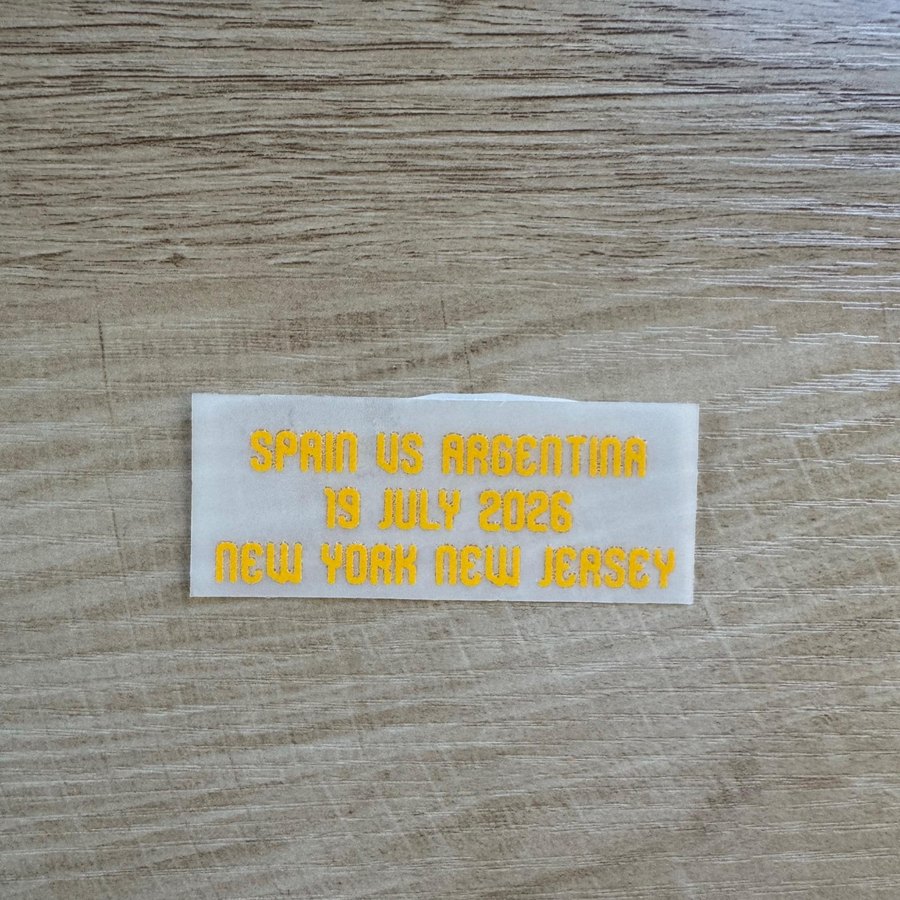
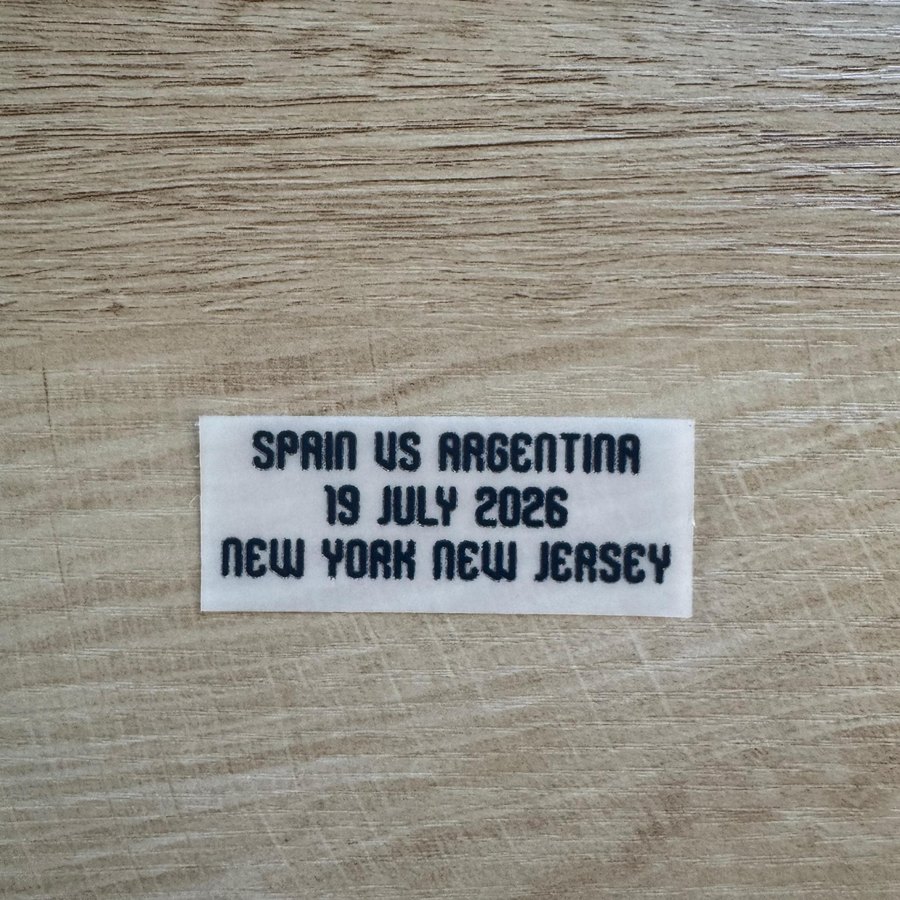
Turning the Spain or Argentina 2026 shirt you already own into a final-day shirt takes exactly one element: the match details text — three short lines reading SPAIN VS ARGENTINA, 19 JULY 2026, NEW YORK NEW JERSEY. It's applied as an iron-on transfer, and it comes in two versions: yellow-gold lettering made for Spain's red home shirt, and deep navy made for light shirts — Argentina's sky blue and white. The lettering sits on a clear backing, so only the text ends up visible on the shirt: no box, no border, no background block. Center it, press it, and the jersey in your closet becomes the jersey from July 19.
Collectors have a name for this kind of small print — a match details transfer, or MDT: the text spec that ties a shirt to one specific game rather than to a whole tournament. The term has its own story, but for this job you only need to make two decisions: which version, and where it goes.
Which version does your shirt take? Gold on red, navy on light
The transfer's color follows the color of the shirt, not the team you support. That's the whole rule, and it's worth memorizing as four words: gold on red, navy on light.
- Gold — yellow-gold lettering, made for the red Spain home shirt. That's the pairing the gold version was cut for.
- Navy — a deep navy that reads almost black, made for light shirts: Argentina's celeste-and-white home look, and white kits in general.
Both versions carry the same three lines, and the text names both teams. That matters more than it sounds: this is not winners-only merchandise. A Spain shirt and an Argentina shirt take the same facts, because the final's date and venue don't pick a side. The only thing that changes between the two versions is which shirt color the lettering was built to stand out against.
The trap: thinking the final-day look requires a new jersey
Since July, nearly every shopping guide has pushed the same answer: buy the new two-star Winners jersey. The fan version runs about $100 at adidas, and other versions aren't slated to ship until November. Nothing wrong with that shirt — but it answers a different question. The Winners jersey is the celebration shirt, produced after the fact, with the outcome already printed on it.
The shirt that was actually part of the night is the one you already own — the one you wore through the tournament and watched the final in. What separates it from the final-day look isn't a hundred dollars of new polyester. It's three lines of text.
And notice who the new-jersey wave leaves out entirely: Argentina fans. The post-final shopping guides push winners gear only; none of it is aimed at the runner-up. If your shirt is celeste and white, the transfer isn't the budget alternative — it's the way to mark the shirt.
Why mark an Argentina shirt? Messi's last World Cup
Within days of the final, the question was everywhere: was that the last time Messi wears the Argentina shirt at a World Cup? The buyer's guides settled on the same framing, calling the Argentina 2026 jersey his last dance.
Here's the collector's problem that creates. An unmarked Argentina 2026 shirt says only that it's from the tournament. It doesn't say the shirt belongs to July 19 — the night of what is widely being treated as Messi's last World Cup match. The match details text is what closes that gap. Date, opponent, venue: once they're on the shirt, it stops being generic 2026 merchandise and becomes a record of one specific game.
That's also why the navy version exists at all. The post-final market only speaks to the winning side; the transfer treats the runner-up's shirt as equally worth preserving. On celeste and white, the near-black lettering does the same job the gold does on red.
Why mark a Spain shirt? The one that earned the second star
Spain's second star — the first new one since 2010 — now prints on the Winners jerseys. But the two-star shirt is the after picture. The shirt Spain's fans wore on the night was the single-star red shirt: the one that went into the final still chasing that star.
That's the version worth marking. Put the gold match details on the red shirt and you've preserved the exact moment the count changed — a one-star shirt carrying the date the second one was won. The two-star jersey, whatever else it offers, can never say that.
Where does the match details text go on the shirt?
On final-day shirts, the match details sit as small print on the chest — that's the placement collectors reference. This transfer doesn't lock you into it, though. It goes where you want it: chest, back, or sleeve.
- Chest — the classic position and the sensible default. Small, centered, quietly declarative.
- Back — reads more like a commemorative print, visible from behind.
- Sleeve — the discreet option; you know it's there.
Two habits will save you from a crooked transfer:
- Center by measuring, not by eye. For the chest, measure in from each side seam so the text sits on the true centerline of the shirt. Eyeballing it against the crest tends to drift.
- Measure twice before any heat. An iron-on transfer doesn't offer second chances. Check that the lines sit level against the hem or the collar seam, step back, look again, and only then commit.
How is the transfer applied?
It's an iron-on: the transfer bonds to the fabric under heat and firm, even pressure. In general terms, the job looks like this:
- Lay the shirt flat and smooth on a hard, even surface.
- Position the transfer on the spot you measured, with the text reading correctly.
- Check the alignment one last time — this is the final free adjustment.
- Apply steady heat with firm pressure across the whole text, not just the middle.
- Let it cool completely before handling the shirt; the bond sets as it cools.
If you'd rather not press it yourself, any local jersey-customization shop can apply a transfer in minutes. And if you want the full pressing walkthrough, our application guide covers the process step by step — the placement decisions above are the part specific to this piece.
A note on this transfer
Both versions carry the same three lines — SPAIN VS ARGENTINA, 19 JULY 2026, NEW YORK NEW JERSEY — with no logos and no crest: on the shirt, only the text shows. The sleeve badges of the final are a separate subject with their own conventions; this is the element that marks the front of the shirt with the facts of the night at MetLife. This guide covers choosing between gold and navy, placing the text, and what the application involves in broad strokes.
FAQ
Which version goes on the red Spain home shirt?
Gold. The yellow-gold lettering was made specifically for the red Spain home shirt. The rule is shirt color, not team: if the shirt you're marking is light, the navy version is the one built for it.
Which version fits Argentina's shirt?
Navy. It was cut for light blue and white kits — Argentina's celeste-and-white home shirt and white shirts in general. The navy reads almost black on the fabric, which is what keeps the small text legible on a light shirt.
Will the transfer show a box or background on the shirt?
No. The lettering sits on a clear backing, so once applied, only the text is visible — the shirt's own color shows through around and between the letters. There's no patch outline, border, or background block.
Does the text have to go on the chest?
No. It goes wherever you want: chest, back, or sleeve. The chest is where final-day shirts carry the small print, so centered on the chest is the default most people should choose — measured from both side seams, checked level, and confirmed before any heat touches the shirt.
Is this only for Spain fans?
No. The text names both teams, so the same facts belong on either shirt. Spain owners mark the red shirt that earned the second star; Argentina owners mark what is widely treated as the shirt from Messi's last World Cup. The navy version exists precisely so the runner-up's light shirts can carry the date too.
Wondering about a specific nation? See what patch your team wears at the 2026 World Cup, or find your team’s patches in the Patch Finder.
Get the patches
Keep reading
What Is the Gold Badge on Spain's Shirt? The World Champions Badge, Explained
world cup 2026 patch by roundWorld Cup 2026 Patch by Round: Which Sleeve Badge for Every Stage
how to apply world cup patch heat pressHow to Apply a World Cup 2026 Sleeve Patch (Heat-Press Guide)
where to buy world cup 2026 sleeve patchWhere to Buy World Cup 2026 Patches & What's a Fair Price (US Shipping)
Patch FC sells heat-press patches for personal jersey customization. Ships from the USA.